ux design · ui design · user research
Sushi Time
Seamless & inclusive reservations.


The Problem
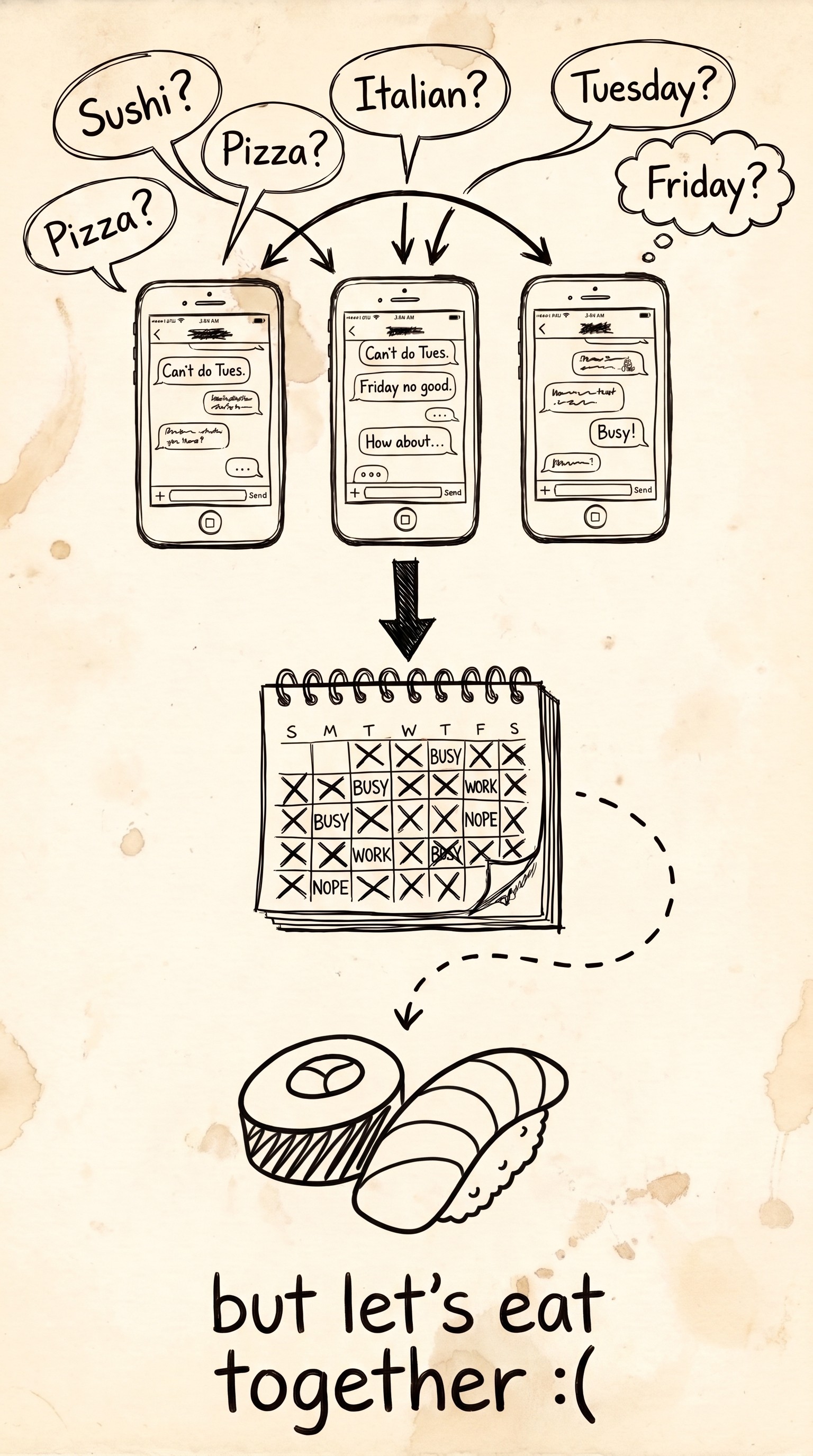
Booking a restaurant for a group is harder than booking for yourself — someone has to check everyone’s availability, gather opinions on where to go, and land on a decision, usually across a scattered group chat. Existing reservation apps are built for individuals, not groups.
After informal interviews, several pain pointswere revealed to address:
Spelling names over the phone
Organizing group reservations
Lack of restaurant information
Canceling or changing a reservation
Talking over the phone gives some people anxiety
Personas
With the pain points in mind, I worked on 3 personas to also cover accessibility concerns from the start.
Ellis Clark
“Memorable experiences with friends worth the world to me”

Ellis is a very tired and busy residency trainee. Despite his full schedule, he likes to spend his free time with friends. They would go to different restaurants around the Seattle area. He thinks that with a strong support group, anyone can achieve anything, so he values his friends the most. He’s a very detail-oriented person who can schedule his life with minimum wasted time. He has dyslexia making his life harder to tell friends which restaurant he wants or spelling thing over the phone.
Demographics
Age: 28
Education: Medical School
Location: Seattle, Washington
Lives with: Alone with two cats
Occupation: Doing residency training
Goals
Find more memorable experiences that he can share with friends.
Try once a lifetime kind of flavors.
Fit experiences in his busy residency training schedule.
Frustrations
Residency is draining him and finding time to socialize and do fun things is very hard.
Delays in his plans makes him lose precious time that he could spend studying.
Hates to spell out his name over the phone.
Robin Bakker
“After years of work, I deserve some fun experiences around the world with my love”

Robin spent her working years as an accountant and she had a successful career. After her daughter left the house for university, Robin and her partner started to travel more often. She is interested in Japanese culture lately and she’s trying to plan a memorable trip there. She wants to taste michelin star sushi restaurants but she figured out that they need to book months prior. She wants to have the best out of such a trip.
Demographics
Age: 61
Education: Business
Location: Rotterdam, Netherlands
Lives with: Married partner
Occupation: Retired
Goals
Find unique experiences that she and her partner can enjoy.
Find good food, great views, and memorable experiences all over the world.
Minimum frustration when making plans.
Frustrations
Negative mismatch between the expected and the actual experience.
Logistical challenges.
When visiting abroad, finding out what was nearby them after they left the country already.
Doesn’t speak the languages where she visits.
Anush Grigoryan
“I love sushi and I want to try new types of it.”

Anush is a freelance developer with mobility impairment and he usually works for American startups. He could save some money during his career and now his work is highly self-paced so he started traveling more often. He has always been interested in food and he would cook for his family when he was young. Now he wants to taste different flavors and he found Japanese cuisine very interesting. He loves sushi and would travel great distances to taste good ones.
Demographics
Age: 44
Education: Computer engineering
Location: Yerevan, Armenia
Lives with: Living alone
Occupation: Freelance developer
Goals
Wants to taste unique foods all around the world and recently interested in Japanese cuisine.
Seeks the flavors he has not tried yet.
Travels for food.
Frustrations
Doesn’t want to eat the same flavors over and over.
Dislike when he doesn’t know what’s included in a menu and end up having a same experience as before
Finding the commute to the restaurant because of his mobility impairment.

Market Research
I compared Sushi Time with Google Maps, OpenTable, and Quandoo to see where existing tools fell short for group dining. None of them addressed group coordination directly: no shared calendar syncing, no way to vote on where to go as a group. I also found accessibility information was consistently thin or missing, like whether a location has wheelchair ramps. Those two gaps became Sushi Time's core differentiators.
Initial Concepts
With the user journeys in mind, I gathered the missing pieces that this application should fill and grouped them into affinity map



Research & Testing
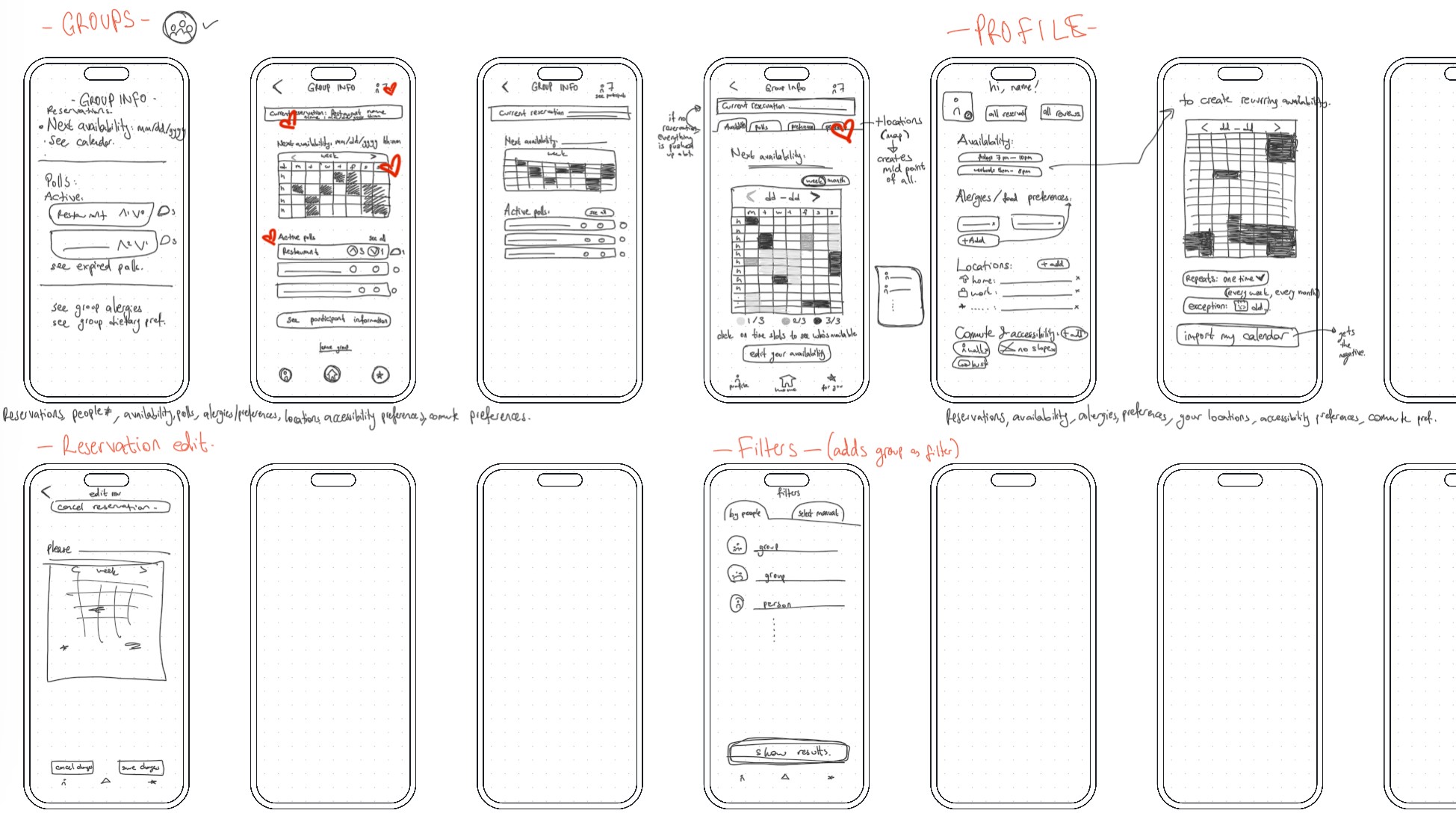
I ran two rounds of usability testing, first on low-fidelity designs, and the next on high-fidelity designs. Both rounds changed the product materially: some features got dropped entirely after testing, others were substantially reworked, and the homepage layout was redesigned after testing showed the original wasn’t landing.
Round one
I tested the lo-fi prototype with 8 participants (2 aged 55+, 6 aged 20–30; 4 male, 4 female) in an unmoderated. The session had a warm-up interview, prototype tasks, and an exit survey.
Key Insights:
Relying on back-button is frustrating → home button.
Chat feature exists in chat apps → something more valuable.
Some buttons were hard to locate → improve visibility and layout.


Round two
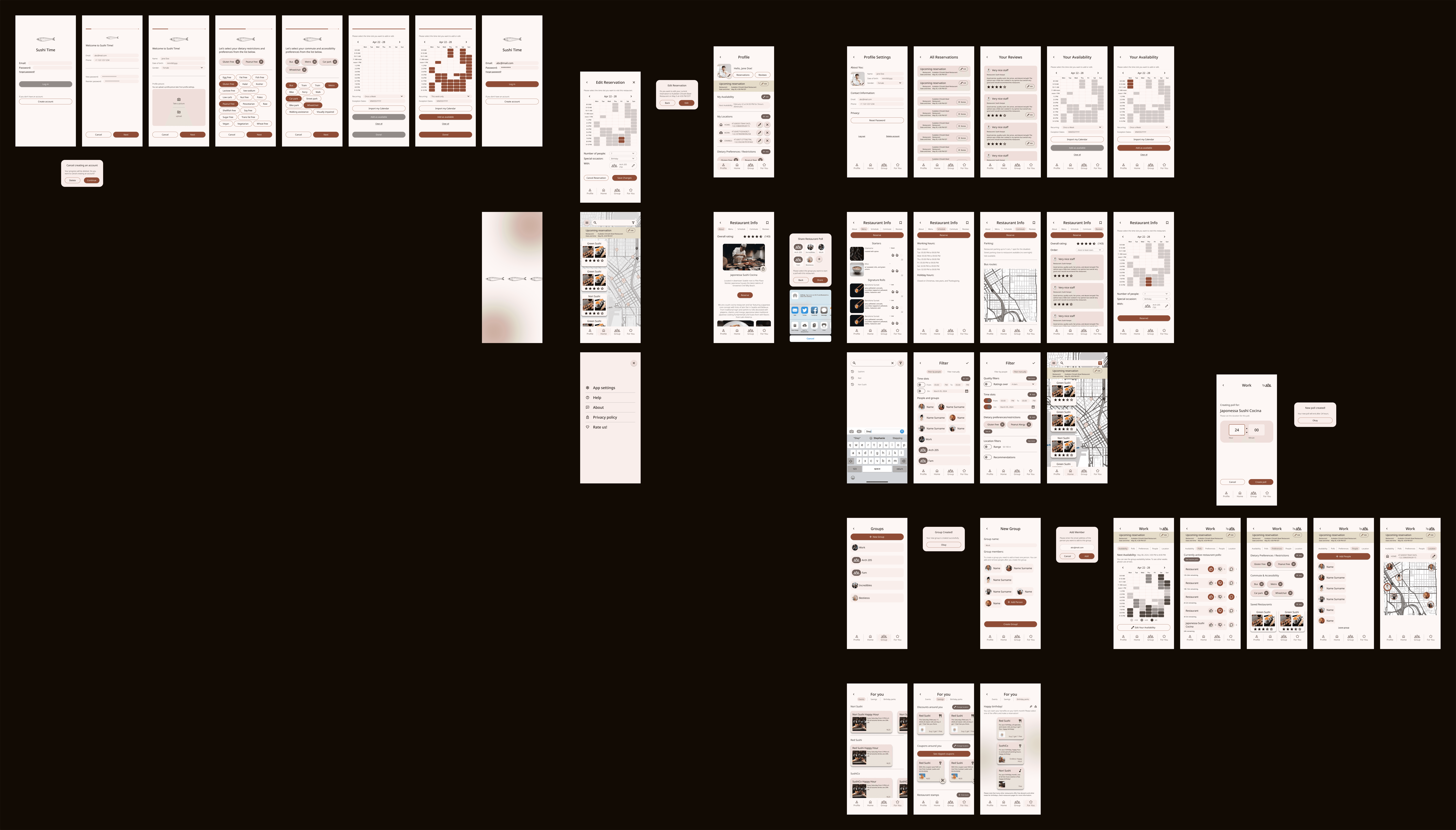
After refining the design based on prior feedback, I developed a hi-fi prototype closely resembling the final product. This round aimed to surface issues with language, flow, layout, and any other emerging concerns.
Key Insights:
Home page felt cramped and hard to use → cleaner spacious layout.
No way to find or join a group → add the functionality.
Map contrast made it visually unappealing → adjust visual comfort.


The Solution
Group booking, structured
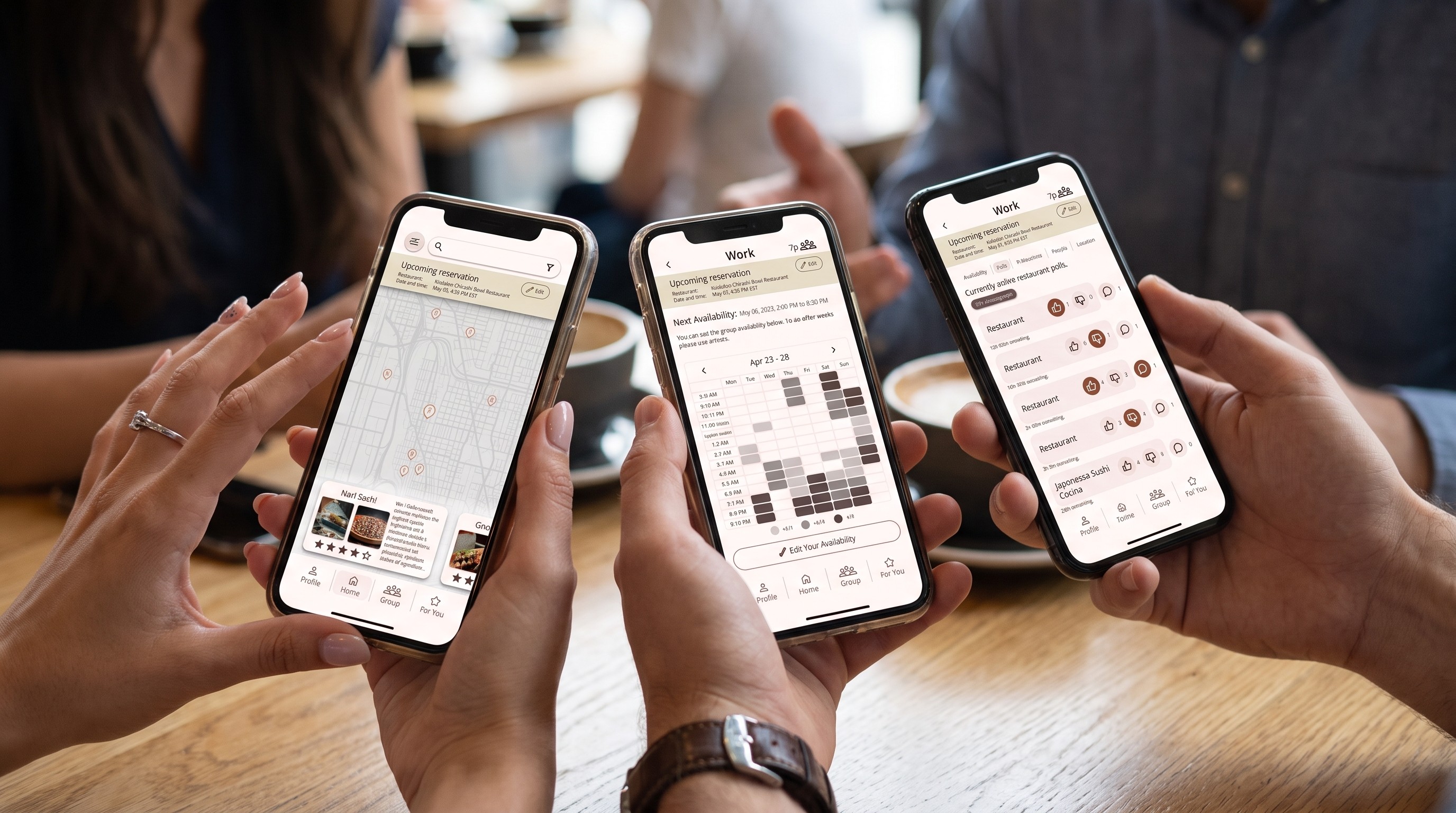
If everyone in the group has an account, the app syncs their calendars to surface shared free time automatically, and lets the group vote on restaurant suggestions with a simple thumbs up/down — turning “where should we go” from a group chat debate into something structured.
Profiles that go deeper
Restaurant profiles go deeper than a typical listing — pulled together like an expanded Google Maps entry, with directions, accessibility details like ramp availability, full menus, hours, the restaurant’s history and story, and user star reviews.
Visual Design
I based the system on Material Design, using its existing components as a foundation but customizing enough that the final product reads as distinct rather than a template. The palette centers on a dark pink-brown as the primary color, with an illustrated fish as the logo mark.


Let’s create together.
I’m open to new opportunities and collaborations. The fastest way to reach me is by email.
© 2026 Pınar Adanır. UX/UI Product Designer.
Designed & built with intention.